Loving God/Loving Neighbor - Rev. Lisa Talbott

Dear Siblings in Christ,
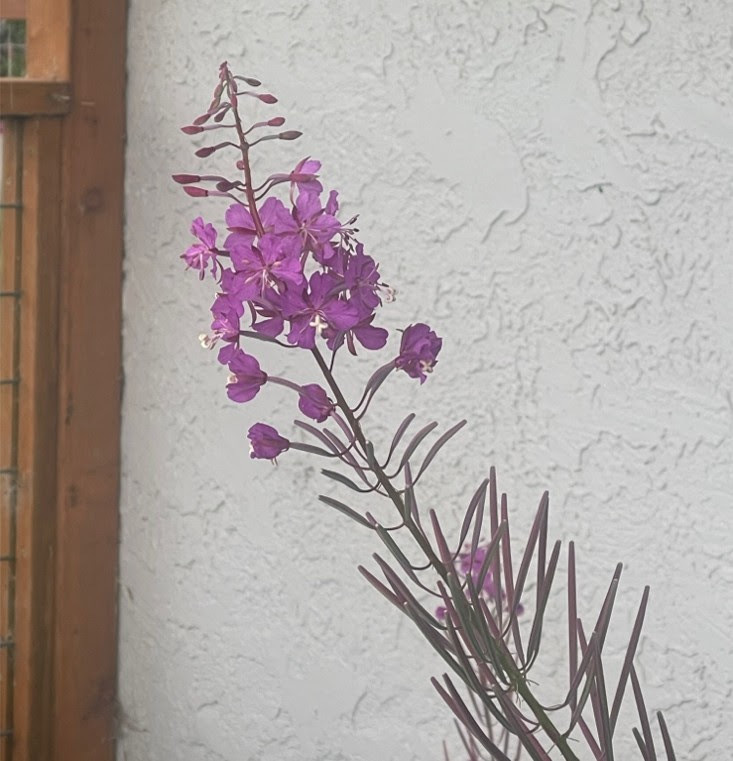
There is a wildflower that grows widely throughout the Northwest, Canada, and Alaska called fireweed, pictured at the top of this newsletter. I've seen fireweed growing along highway shoulders all through Washington. In Alaskan summers, I've seen fireweed that is taller than our shed roof, reaching up toward the midnight sun.
When I was at Sawtooth Camp outside of Fairfield, Idaho, a couple of weeks ago, the fireweed was only about a foot tall. This surprised me because I am so accustomed to seeing fireweed growing in vast fields, almost like shrubs. Instead, at Sawtooth Camp, the fireweed grew lone and low, no doubt because of the blazing heat and lack of water.
Curious if we shared more than just flora across our region, I asked a local, “Do you have a legend about fireweed topping out here?” From the puzzled expression, I could tell the answer was no. So I shared the legend of fireweed in Alaska.
Fireweed blooms from the bottom up in a conical shape, with large flowers at the bottom and small oval buds at the top. In Alaska, fireweed is a barometer of the season—the slower the fireweed blossoms, the longer the summer. As the blooms travel up the stalk, we can watch the season passing. And when those last few buds open at the very tip, summer is over. When the fireweed "tops out," winter is just six weeks away.
All across our region, we share this beautiful, medicinal plant. But people and communities can encounter it and understand it in very different ways—as a weed, as just another wildflower, as a forager’s delight, or as a significant indicator of the passage of the seasons. We share a tangible object, but we may look at it in very different ways.
And the only way to begin discovering those differences is to become curious. Ask questions. Listen. Set our assumptions aside. Be willing to discover that something we have always understood one way might look very different from another person’s perspective.
That kind of curiosity takes courage. It asks us to step outside our own point of view—not because our experience doesn't matter, but because our experience is never the whole story. It asks us to listen deeply enough that what we hear might change us.
This weekend, you are invited to Loving God | Loving Neighbor: Intercultural Competency for Community Engagement, a workshop that your Leadership Board has invited me to lead in the Friendship Room on Saturday from 9am-3pm. Even if you can’t make it to the workshop on Saturday, I will be preaching in worship on Sunday and I hope to see you there. Both events are accessible in person or on Zoom and open to everyone.
The main lesson I hope we practice together is to have the courage to be curious: to become curious about one another, to explore what it means for something to be a weed to one person but a wonder to another, and to discover how God might be calling us to see our neighbors—and ourselves—with new eyes.
I hope you will join me.
Peace,
Lisa